
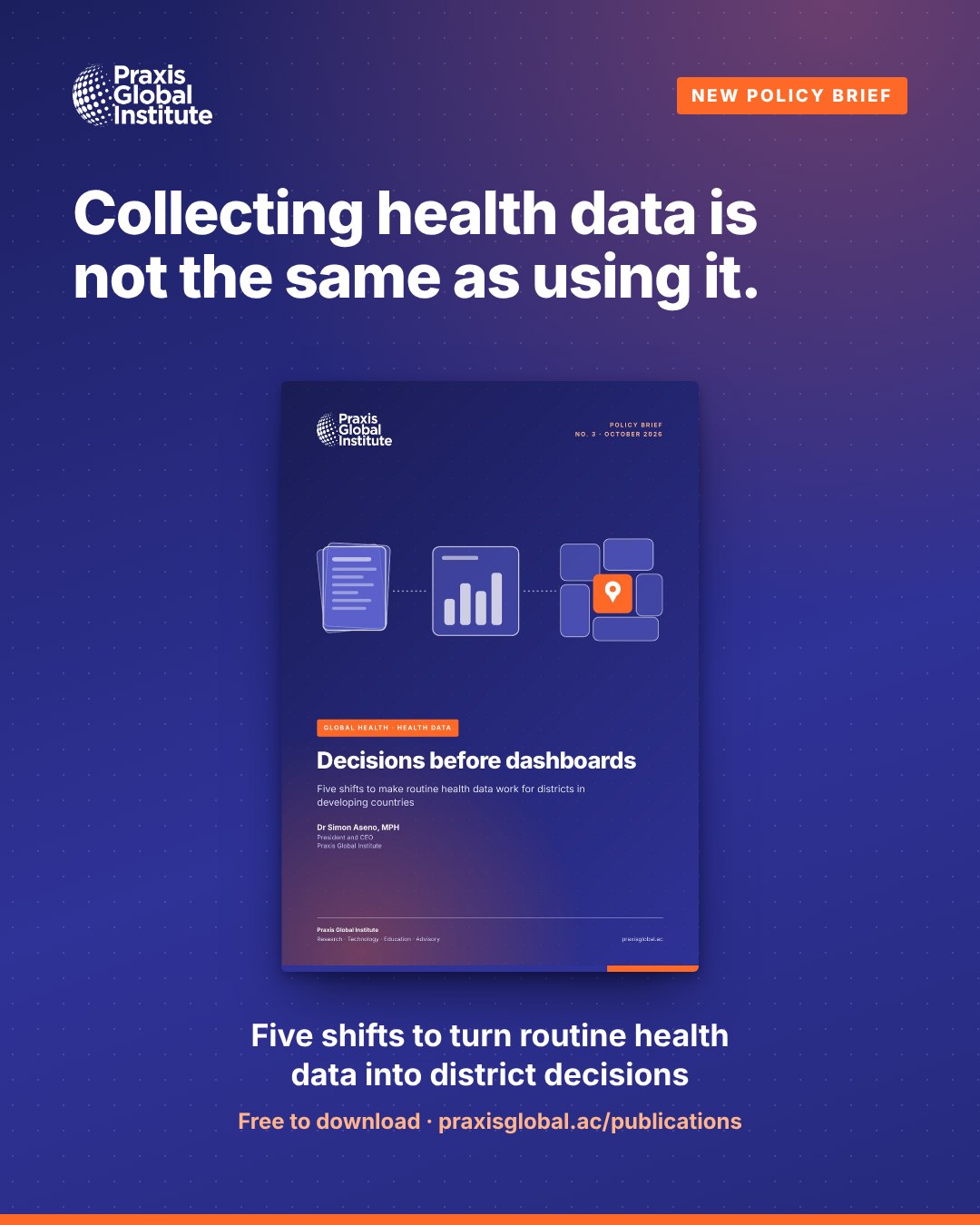
Decisions before dashboards
Five shifts to make routine health data work for districts in developing countries
Districts in many low- and middle-income countries report health data on time but rarely use it to decide. This brief sets out five shifts that make district decisions, not reporting rates, the test of a routine health information system.
Free to download and share. No sign-up needed. Print-ready A4 with full-colour figures.
Thank you for downloading. Want the next one in your inbox? Add your email below.
- Series
- Praxis Policy Brief No. 3
- Publication ID
- PGI-PB-2026-03
- Published
- 31 October 2026
- Length
- 13 pages, A4
- Licence
- CC BY 4.0
Key messages
- Reporting is not using. In one Ghanaian region, 93% of facilities studied submitted data to the national platform, but only 26% of community-level facilities used those data in annual action plans (2020 study).
- The burden falls on front-line staff. A five-country study found an average of 34 registers and 35 monthly reporting forms per country, with recording taking about one-third of consultation time.
- Quality problems are real but fixable. A ministry-led data quality intervention in Mozambique raised median agreement between source records and reported data from 56.3% to 87.5%.
- Use depends on management, not software. Regular review meetings, supervision, feedback and direction from senior managers predict data use more than technology alone.
- The aid shock raises the stakes. In a 2025 WHO survey of 108 country offices, over 40% of countries reported disruption to key information systems.
Who this brief is for
Ministries of health, district health management teams, health information and monitoring and evaluation officers, and the donors, global health partners and NGOs whose reporting requirements shape what facilities collect.
Inside the brief
- Abstract, key messages and the context after the 2025 aid cuts
- Evidence on data use, data quality and the reporting burden from across sub-Saharan Africa
- Cases from Kano State, Nigeria, and Sofala and central Mozambique
- The strongest case against relying on routine data, and a response
- Five shifts for ministries, districts and partners
- A district data-use checklist, eight questions for leaders and a 90-day plan
- Twenty references, each linked to its source
For enquiries about this brief, email Simon at [email protected].
Praxis supports better use of evidence through Research & Data, builds data skills through Education & Training and works with teams and leaders through Advisory & Partnerships. To discuss your plans, contact us.
How to cite
Aseno, S. B. (2026). Decisions before dashboards: Five shifts to make routine health data work for districts in developing countries (Praxis Policy Brief No. 3, PGI-PB-2026-03). Praxis Global Institute. https://doi.org/10.5281/zenodo.23407130
Get the next brief, toolkit or report first.
Join Praxis Insights and receive each new Praxis publication by email, with a short summary and a direct download link, plus occasional articles. Downloads stay free whether you subscribe or not. Unsubscribe at any time.