
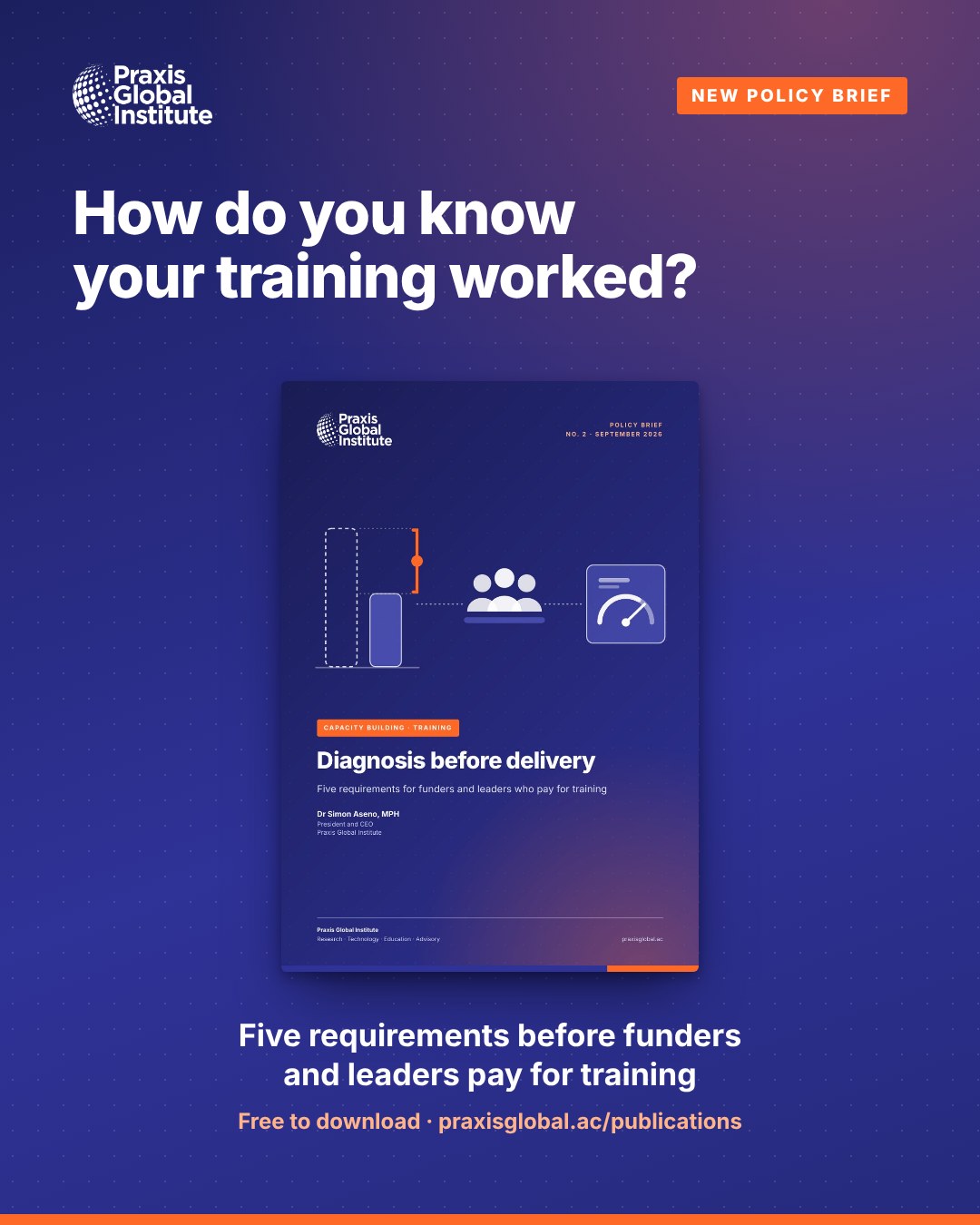
Diagnosis before delivery
Five requirements for funders and leaders who pay for training
Training is often judged by how many people attended, not by what changed afterwards. This brief sets out five requirements funders and leaders should attach to every training investment, from a performance diagnosis before delivery to evidence of behaviour and results after it.
Free to download and share. No sign-up needed. Print-ready A4 with full-colour figures.
Thank you for downloading. Want the next one in your inbox? Add your email below.
- Series
- Praxis Policy Brief No. 2
- Publication ID
- PGI-PB-2026-02
- Published
- 23 October 2026
- Length
- 13 pages, A4
- Licence
- CC BY 4.0
Key messages
- Training is often counted, not evaluated. The World Bank’s Independent Evaluation Group found in 2008 that project completion reports “seldom report on more than the numbers of persons trained”.
- Learning is not the same as changed practice. In the same evaluation, most World Bank-financed training produced individual learning, but it improved the capacity of client institutions only about half the time.
- Targeting matters most, and it starts with analysis. The World Bank evaluation found that the targeting of training content was the most important design factor driving training success.
- Training alone has moderate effects; training plus support does better. A 2018 systematic review of health-worker performance in low- and middle-income countries found that combining training with supervision typically outperformed either strategy alone.
- Funders hold the lever. If funders and boards require a needs analysis before approval and evidence of behaviour change after delivery, providers will design for performance rather than attendance.
Who this brief is for
Development partners, foundations and ministries of finance; ministries and public agencies that commission training; boards and executive leaders; and the human resources, learning and programme teams who plan and budget for training.
Inside the brief
- Abstract, key messages and the case for the two most-skipped phases of ADDIE: analysis and evaluation
- Evidence from a World Bank evaluation, meta-analyses of training transfer and systematic reviews of health-worker performance
- Why analysis and evaluation get skipped, and the strongest counter-arguments
- Five requirements for funders and leaders, with the Kirkpatrick levels to measure
- A funder checklist, eight questions for boards and a 90-day plan
- Fifteen references, each linked to its source
For enquiries about this brief, email Simon at [email protected].
Practitioner methods will follow in Praxis Toolkit No. 1, From training to practice. Praxis builds professional capability through Education & Training and supports institutional change through Advisory & Partnerships. To discuss your plans, contact us.
How to cite
Aseno, S. B. (2026). Diagnosis before delivery: Five requirements for funders and leaders who pay for training (Praxis Policy Brief No. 2, PGI-PB-2026-02). Praxis Global Institute. https://doi.org/10.5281/zenodo.23407122
Get the next brief, toolkit or report first.
Join Praxis Insights and receive each new Praxis publication by email, with a short summary and a direct download link, plus occasional articles. Downloads stay free whether you subscribe or not. Unsubscribe at any time.